
Diabetic-Friendly Meal Delivery Without the Blood Sugar Rollercoaster
Most “diabetic meals” don’t fix the problem — they just shrink the portion.
We build meals differently: real ingredients, balanced macros, and zero industrial oils — because stable blood sugar isn’t luck.
No refined sugars. No shortcuts. No guessing how your food will hit you.
Built for people who are done playing roulette with their meals.
Our meals are built for people who want real food without hidden ingredients, industrial oils, or blood sugar guesswork.
This Isn’t Just About Sugar — It’s About Everything Behind It.
Let’s be honest — most “diabetic-friendly” meal options don’t actually solve the problem.
They just repackage it.
You’ll see:
- Smaller portions
- Lower calorie counts
- Labels that sound right
But when you look closer…
The ingredients haven’t changed.
Most of these meals are still built with:
- Refined carbohydrates and processed sugars that hit fast and hard
- Low-quality fats
- Minimal protein
- Hidden sugars and sweeteners that spike blood sugar without you realizing it
- Little to no consideration for how the meal actually functions once you eat it
So what happens?
Most “diabetic-friendly” options don’t fix that.
They just shrink portions…
while keeping the same ingredients that caused the problem in the first place.
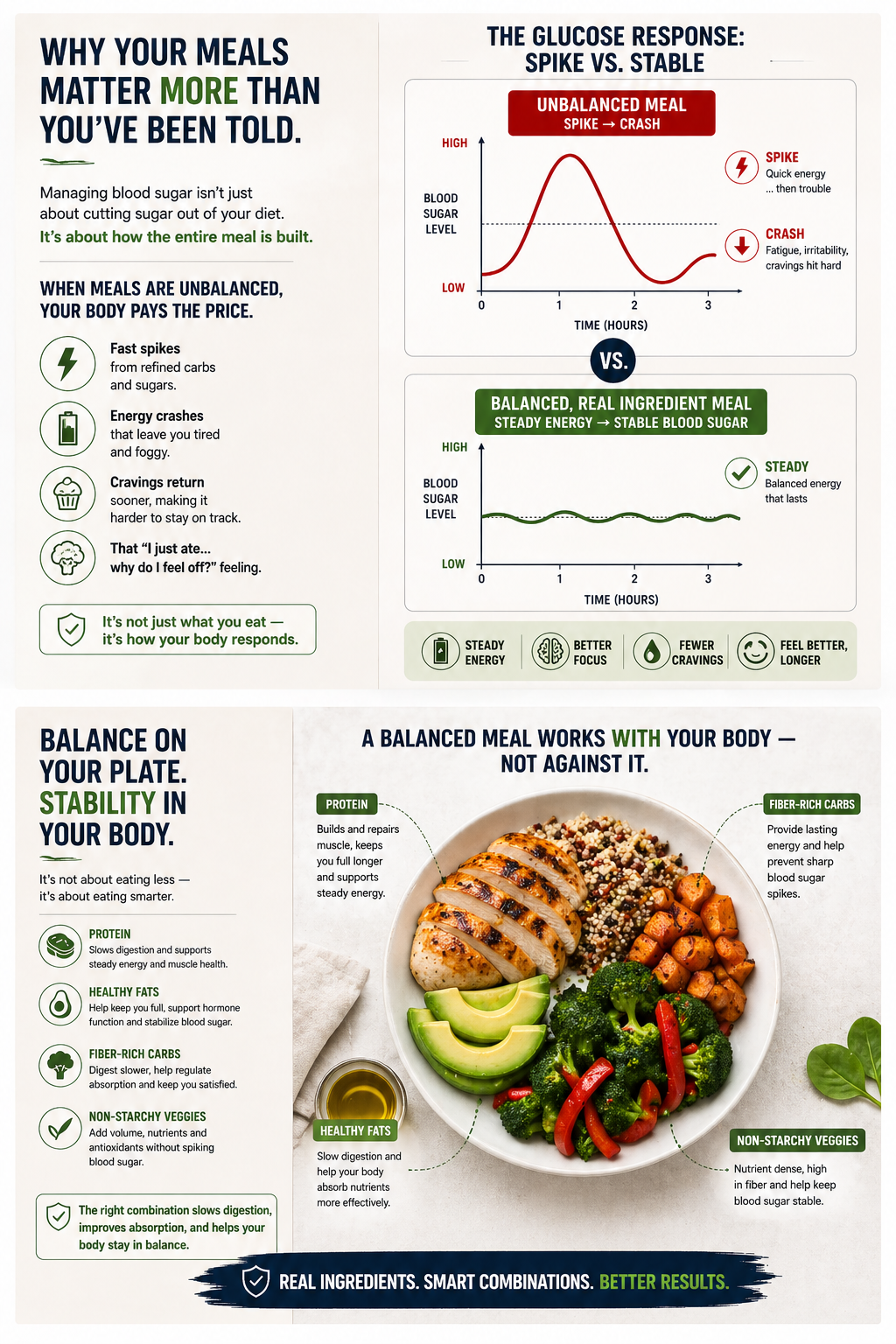
Why Your Meals Matter More Than You’ve Been Told
Managing blood sugar isn’t just about cutting sugar out of your diet.
For many people, it comes down to how the entire meal is built.
Things like:
- Refined carbohydrates
- Low-quality fats
- Lack of protein
- Lack of fiber
…can all contribute to fast spikes followed by hard crashes.
That’s when you get:
- Energy swings
- Cravings not long after eating
- That “I just ate… why do I feel off?” feeling
Stable blood sugar isn’t about one ingredient.
It’s about how everything on your plate works together.
Not all carbohydrates — or sweeteners — hit your body the same way.
That’s why we focus on lower glycemic ingredients when they’re used — and more importantly, how they’re used within a balanced meal.
Because:
- Protein slows digestion
- Fats help stabilize energy
- Fiber helps regulate absorption
It’s the combination that changes the outcome.
And that’s where most “diabetic-friendly” meals miss the mark.
They focus on what to remove…
but ignore how the meal actually functions once you eat it.
Why Most “Diabetic-Friendly” Meals Miss the Mark
Most companies will tell you what’s in the meal.
They won’t tell you what it’s cooked with — or why it matters.
They’ll highlight protein.
They’ll talk about calories.
They’ll market “healthy”.
But none of that tells you how the meal is actually going to hit your body.
What You’ll Find In Most “Diabetic-Friendly” Meal Prep.
Most meal prep companies — and most restaurants — don’t actually build meals for blood sugar control.
They build for cost, shelf life, and convenience.
And that changes everything about how the food hits your body.
What that usually looks like:
- Refined carbohydrates and fast-digesting ingredients that spike blood sugar quickly
- Hidden sugars and sweeteners that don’t show up the way you think
- Low protein meals that don’t support stable energy
- Fats chosen for shelf stability — not how your body processes them
- “Diabetic-friendly” labels based on calories — not how the meal actually performs
You’re not just eating the meal.
You’re dealing with what happens after it.
Most of those meals don’t control blood sugar —
they just make it harder to predict.
How Our Meals Are Built Differently.
Built For Balance — Not Just Portions
Every meal includes protein, fats, and carbohydrates working together — not isolated ingredients that spike and crash.
No Refined Sugars
No high fructose corn syrup. No cheap processed sweeteners.
Sweetness, when used, is intentional — not hidden.
Carbohydrates That Don’t Hit All At Once
We focus on how ingredients digest and absorb — not just what shows up on a label.
Protein That Actually Supports Stability
Meals are built to help slow digestion and support more consistent energy.
Fats That Work With Your Body
Real, functional fats that help support energy and satiety — not ingredients chosen just for shelf life.
Consistency You Can Actually Feel
Meals built the same way, every time — so your body isn’t guessing what’s coming next.
No guessing. No spikes you didn’t see coming.
Just meals that work with your body — not against it.
Because “Diabetic-Friendly” Should Mean More Than A Label.
It Should Mean Meals Built To Help You Stay Steady.
No refined sugars. No blood sugar roulette. Just real meals built for better balance, steadier energy, and fewer “why do I feel like crap?” moments..
When Your Meals Are Built Right — Your Body Responds Differently
This isn’t guesswork — it’s how your body processes food.
Meals built with:
Refined carbohydrates
Processed sugars
Low protein
Poorly balanced fats
…tend to create:
Rapid blood sugar spikes
Energy crashes shortly after eating
Increased cravings
Inconsistent energy throughout the day
When those inputs stay the same —
your body keeps reacting the same way.
When meals are built differently — consistently —
things start to shift:
Blood sugar becomes more stable
Energy feels more even throughout the day
Cravings become less frequent
You’re not guessing how each meal will hit you
Not because of a trend.
Not because of a “diet hack.”
Because the inputs finally changed.
Most people try to fix the symptoms:
- Eat less
- Cut carbs randomly
- They cut out carbs
- Follow whatever label sounds right
- Listened to the latest trending Nutrition influencer.
But if the structure of the meal doesn’t change:
You get the same spikes
The Same Crashes
The same frustration
That’s not control.
That’s just guessing with better branding.
If it causes spikes and crashes, it’s not built for blood sugar — no matter what the label says..
Here’s Where Most “Healthy” Food Still Misses
Most people think they’re eating better.
They buy what they believe is higher quality.
They read labels. But do they really.
They choose what looks clean. Or what they’ve told is clean.
But here’s the problem:
The meals are still built the same way.
And that’s the part that never changes.
So the outcome doesn’t change either:
- Blood sugar still spikes
- Energy still crashes
- Cravings keep showing up
- That “off” feeling never fully goes away
So people keep adjusting everything else…
- Cutting carbs
- Skipping meals
- Chasing the next “diabetic-friendly” label
- Trying whatever sounds like it might work
Except the one thing that actually controls the outcome.
How the meal is built.
And the industry knows it.
Because it’s easier to market “healthy”…
than it is to build meals that actually perform.
You don’t need another diet.
You don’t need to guess your way through another week.
You need meals that don’t work against you.
If it causes spikes and crashes, it’s not built for blood sugar — no matter what the label says.
No guesswork. No shortcuts. No “close enough.”
Just real food — built the way it should’ve been all along.
What Labels Don’t Tell You About Sugar
Most people think they’re avoiding sugar.
They’re not.
They’re just avoiding the word “sugar.”
Food labels don’t always say “sugar.”
Even major health organizations like the Cleveland Clinic note that added sugars often appear under dozens of different names on ingredient labels.
There are more than 50… 60… even hundreds of variations depending on how they’re processed.
And as the CDC points out, many of these show up in foods you wouldn’t expect — sauces, breads, packaged meals, and even products marketed as “healthy.”
- Syrups (corn syrup, brown rice syrup)
- “Natural” sweeteners (cane juice, agave, fruit concentrate)
- Glucose-based additives (dextrose, maltodextrin)
- Processed carbs that act like sugar (starches, refined grains)
Different names. Same outcome.
Your body doesn’t care what it’s called.
It only cares how fast it hits your bloodstream.
Some products contain multiple forms at once — making the total impact even higher than it looks.
Why It Feels So Hard To “Just Eat Better”
If it feels like you’re constantly fighting cravings…
That’s not a lack of discipline.
Most people think it’s about willpower.
It’s not.
It’s about what your body is being fed — over and over again.
Meals built with fast-digesting carbs, hidden sugars, and poor balance don’t just affect your energy…
They change what you want next.
- You eat → blood sugar rises fast
- It drops shortly after
- You feel hungry again — sooner than you should
- You start craving something quick
- And the cycle repeats
That’s not you failing.
That’s the pattern working exactly how it was designed to.
And it’s everywhere:
- Fast food
- Packaged meals
- “Healthy” snacks
- Even foods labeled “diabetic-friendly”
“Quick energy in… crash out… repeat.”
So now it’s not just a choice…
It’s your environment, your habits, and your biology all pulling in the same direction.
No one wins that fight long-term.
That’s why this isn’t about trying harder.
It’s about changing what’s driving the cycle in the first place.
Not All Sweetness Hits The Same
Most people hear “cut sugar” and assume all sweetness is the same.
It’s not.
Different sweeteners are processed differently by the body.
Some hit fast — and can contribute to spikes and crashes.
Others are absorbed more slowly, especially when used in smaller amounts and paired with protein, fats, and fiber.
But here’s what most people miss:
It’s not just the sweetener.
It’s how it’s used inside the meal.
That’s where most “diabetic-friendly” options fall apart.
They don’t remove the problem —
they just rename it.
When we use sweetness, it’s intentional.
- No refined sugars
- No hidden sweeteners
- No processed foods
- No dumping it into every meal
We use options that have generally lower glycemic index —
and only where they actually belong.
Because the goal isn’t to make food sweet.
It’s to make it work better in your body.
That’s a big difference from most options out there —
where sweetness is often hidden, not controlled.
This Is For You If:
- You’re tired of eating “healthy” and still dealing with spikes, crashes, and energy swings
- You want more stable blood sugar — not something you’re constantly guessing at
- You’ve noticed how differently certain meals hit you… and you want that to stop being unpredictable
- You’re done with the cycle of eat → crash → crave → repeat
- You want meals that work the same way every time — not “maybe this works”
- You care about how food actually affects your body — not just what the label says
This Isn’t For You If:
- You’re fine riding your spike and crash cycle every day
- You don’t care how your meals affect your energy, cravings, or blood sugar long-term
- You’re okay with “probably fine” instead of actually knowing how your food works. We wipe our a$$es with fine.
- You think all “healthy” food behaves the same once you eat it
- You’re just looking for the cheapest option — not the one that actually works
Once Your Meals Are Built Right — You Stop Guessing How You’re Going To Feel.
At some point, you either change what’s driving the spikes…
or you keep dealing with the same cycle.
Give it 90 days.
Not a week.
Not when it’s convenient.
Because this only works when the inputs actually change — consistently.
When your meals stop working against you…
Everything else starts to level out.
Your body will tell you the difference.
Funny how cheap food feels like a win at checkout — or at that drive-thru…
but what you pay for after hits a lot harder.
Stop paying for your meals twice.
Build your week with meals that actually work with your body — not against it.
Cheap food is expensive when you feel it every day.
Stop Guessing How Your Meals Are Going To Hit You
You shouldn’t have to wonder how you’re going to feel after you eat.
With Fire Dept. Meals, you know exactly what you’re getting — every time.
Energy shouldn’t be unpredictable.
Cravings shouldn’t run the day.
Most people try to fix how they feel…
without ever fixing what’s causing it.
Give it 90 days
Not a Weeek – Not when it’s convenient.
Because stability doesn’t come from one “good” meal —
it comes from consistency.
Consistency is where everything starts to change.
Most “healthy” meal prep uses highly refined sugars, indredients ending “ose”
That’s why nothing actually changes.
Consistency is where the shift happens.
No subscriptions required. No pressure.
Just meals built to work with your body — every single time.
How It Works (Without The Guesswork)
Pick your meals. We handle the rest.
Stay consistent — without overthinking every bite.
1. Choose Your Meals
Pick from a rotating menu built for balanced energy and stable blood sugar — not spikes and crashes.
No hidden inputs.
No “probably fine.”
Just food you don’t have to second-guess.
Every Meal Is Built To Work The Same Way — Every Single Time.
2. We Prep Everything Fresh
Every meal is prepared in controlled batches using real ingredients, balanced macros, and no refined sugars.
No shortcuts.
No mass production.
Built for how your body actually responds — not just what looks good on a label.
If It Doesn’t Support Stability, It Doesn’t Go Out. Period.
3. Delivered ready to heat
Your meals arrive fresh and sealed.
No prep. No cleanup. No extra decisions.
Heat. Eat. Move on with your life.
Built to be repeated — week after week.
4. Stay Consistent
This is where everything changes.
When your meals stop working against you —
your body finally has a chance to stabilize.
Energy levels out. Crashes happen less often. You stop guessing how you’re going to feel.
This Is Where Food Starts Working With You — Not Against You.
No Complicated Plans. No Guessing. Just Meals That Work The Way They’re Supposed To.
Most “healthy” meal prep still focuses on calories and labels…
Not how your body actually responds after you eat it.
That’s why nothing feels consistent.
This does.
Real questions. no sugarcoated Answers.
What makes a meal “diabetic-friendly”?
Answer: Most companies define it by calories or sugar content.
We don’t.
A truly diabetic-friendly meal is built to support stable blood sugar after you eat it — not just look good on a label.
That means balanced protein, fats, and carbohydrates working together — not fast-digesting ingredients that spike and crash.
Will these meals spike my blood sugar?
Answer: No meal can guarantee zero impact — that’s not how the body works.
What matters is how fast and how hard it hits.
Our meals are built to avoid sharp spikes and crashes by focusing on balance, ingredient quality, and how the body processes the food — not just numbers on a label.
Do you use sugar or sweeteners at all?
Answer: We don’t use refined sugars or hidden sweeteners.
When sweetness is used, it’s intentional and controlled — not something added to everything.
We use options like organic agave, organic date syrup, organic coconut nectar, and similar lower-glycemic sources — in small amounts and only where they actually belong.
The goal isn’t to eliminate flavor.
It’s to avoid ingredients that create unpredictable spikes and crashes.
Are these meals low glycemic?
Answer: We don’t build meals around a single number.
Glycemic response depends on the entire meal, not just one ingredient.
Our focus is on how everything works together to support steady energy and stable blood sugar — not isolated metrics.
How are these different from other “healthy” meal prep services?
Most meal prep companies focus on:
Calories
Macros on paper
Marketing labels
We focus on:
How your body actually responds after you eat
Consistency from meal to meal
Removing ingredients that cause spikes and crashes
That’s a completely different approach.
Do I need to track anything while using your meals?
Answer: No.
These meals are built so you don’t have to overthink every bite.
No tracking. No guessing.
Just consistent inputs your body can rely on.
Are these meals good for weight loss too?
Answer: Yes — but that’s not the primary goal.
When blood sugar is more stable, energy improves, cravings decrease, and consistency becomes easier.
That’s what supports sustainable weight loss.
Will I feel a difference right away?
Answer: Everyone is different.
Most people don’t notice a dramatic change overnight —
they notice things becoming more consistent over time.
That’s the goal.
Are these meals bland or restrictive?
Answer: No.
They’re built to be repeatable — which means they have to taste good.
The difference is we don’t rely on hidden sugars or processed ingredients to create flavor.
Is This Worth It ComIs this just another “diet”?
Answer: No.
Diets focus on restriction.
This is about removing what doesn’t work — and replacing it with meals your body can actually handle consistently.
What if I’ve tried “diabetic-friendly” meals before and they didn’t work?
Answer: Most of those options are still built with fast-digesting carbs, hidden sugars, or poor balance.
That’s why the results don’t change.
This approach focuses on how the meal performs after you eat it, not just how it looks on paper.
Is This For People With Health Issues — Or Just Anyone?
Answer: Both — but it matters more for some.
If you’re dealing with:
Inflammation
Gut issues
Energy crashes
Food sensitivities
Then what you eat — and how it’s made — matters more.
This just removes the guesswork.
How often should I eat these meals?
Answer: Consistency matters more than perfection.
Most people use these meals regularly throughout the week to reduce variability and keep things predictable.
Can I mix these with my own meals?
Answer: Yes.
But the more consistent your inputs are, the more consistent your results will be.
Are these meals pre-cooked?
Answer: Yes.
They arrive fresh and ready to heat — no prep, no cleanup, no extra decisions.
Do you offer options for other dietary needs (gluten-free, low sodium, etc.)?
Answer: Yes.
We offer multiple meal options designed to fit different dietary needs while still maintaining the same core standards.
Do I Have To Commit To A Subscription?
Answer: No — but one week won’t tell you much.
You can order one week at a time. No subscriptions. No pressure.
But here’s the reality:
If your body’s been dealing with the same inputs for years…
it’s not flipping a switch in 5 days.
Consistency is where the change happens.
And when the inputs finally change — that’s when people start noticing the difference.
Stop Guessing How You’re Going To Feel After You Eat.
Most people don’t realize how inconsistent they’ve been feeling…
until they finally give their body something it can rely on.
You don’t need perfect.
You need consistent.
Start with one week. Pay attention to how you feel. Then decide.