
Low Sodium Meal Delivery Built For Balance — Not Bland, Processed Food
Most people aren’t eating “high sodium” on purpose — it’s built into everything.
Most “low sodium” meals strip everything out and call it healthy.
These are built differently — controlled sodium, real ingredients, and meals that actually work in your body.
NO HIDDEN SODIUM. NO SHORTCUTS. NO GUESSING HOW YOUR FOOD WILL HIT YOU.
Built for people who are done playing roulette with how they feel after they eat.
Our meals are built for people who want real food without hidden ingredients, excessive sodium, or processed shortcuts.
This Isn’t Just About “Low Sodium” — It’s About How The Food Is Actually Built
Let’s be honest — most “low sodium” meals don’t actually solve the problem.
They just repackage the same problem.
You’ll see:
- Smaller portions
- Lower numbers on the label
- “Heart healthy’ claims
But when you look closer…
The way the food is built hasn’t changed — and neither have the ingredients.
Most of those meals are still built the same:
- Processed ingredients loaded with hidden sodium
- Sauces, broths, and preservatives designed for shelf life — not performance
- Flavor systems used to cover lower quality ingredients
- Little to no focus on how the meal actually functions once you eat it
So what happens?
Most “low sodium” options don’t fix the real issue — they just make it look better on paper.
And what you see on the label doesn’t always tell the full story.
They just reduce the number — or hide it —
while keeping the same system that caused the problem in the first place.
Less sodium doesn’t mean better food — if everything else stays the same.
Why Your Sodium Intake Is Higher Than You Think
Most people aren’t adding too much salt.
They’re eating it — over and over — without realizing how much is already built into their food.
And it adds up fast.
Where It’s Actually Coming From:
- Processed sauces, marinades, and dressings
- Pre-cooked meats and packaged proteins
- Broths, stocks, and “flavor enhancers”
- Preservatives used to extend shelf life
- Meals built for convenience — not control
None of it looks excessive on its own.
But together, it stacks into something your body has to deal with all day.
That’s When Things Start To Feel Off:
- Water retention and bloating
- Constant thirst
- Blood pressure creeping up
- Feeling heavy after meals
- Energy that feels… flat
Not because you added salt.
Because it was already there — everywhere.
The Real Issue Isn’t Just “Too Much Sodium”
It’s where that sodium is coming from.
Most “low sodium” meals don’t actually change that.
They just:
- Shrink the portion
- Lower the number on the label
- Keep the same processed system behind it
So the intake looks better…
But the structure of the food hasn’t changed.
It’s Not About Removing Salt — It’s About Removing The Overload
Your body needs sodium.
But it needs it in forms it can actually use —
not hidden inside ultra-processed ingredients designed for shelf life.
When You Change That, Everything Shifts:
- Sodium intake becomes controlled — not stacked
- Meals feel lighter, not bloated Hydration improves
- Energy feels cleaner
- Your body isn’t constantly compensating
Because It Was Never Just About Salt
It was about how the food was built.
**And Once You Fix That —
You Stop Fighting What You’re Eating.**
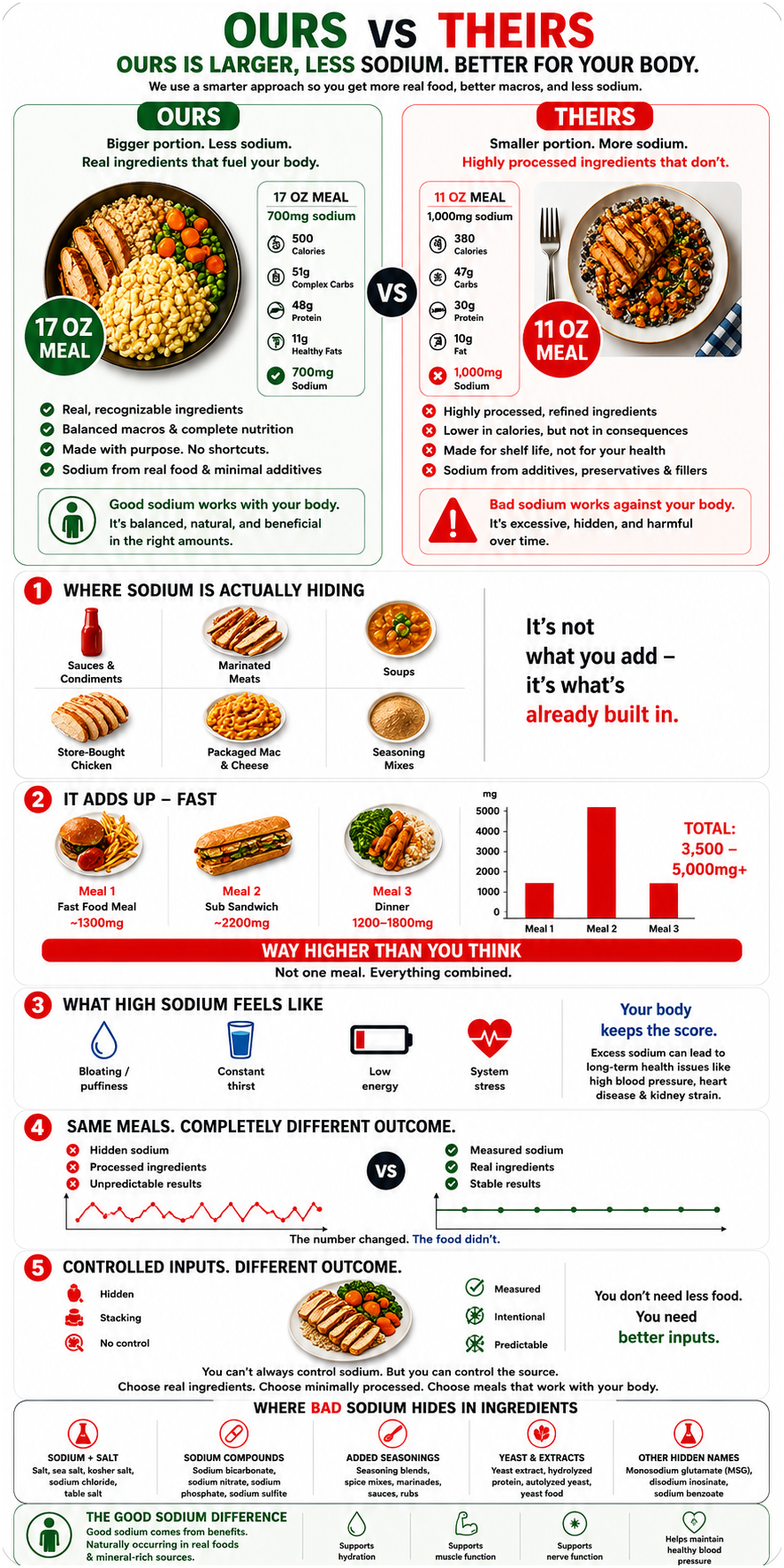
You’re not dealing with a sodium problem.
You’re dealing with a food system problem.
Fix the inputs —
and your body stops paying the price.
Start with one week.
Feel the difference. Then decide
Why “Low Sodium” Doesn’t Mean What You Think It Does
Most companies might show you a number.
But they won’t show you how that number got there — or what it actually means once you eat it.
You’ll hear things like:
- “Reduced sodium”
- “Heart healthy”
- “Better for you”
BUT NONE OF THAT TELLS YOU HOW THE MEAL IS ACTUALLY GOING TO HIT YOUR BODY.
Because “low sodium” usually just changes the label — not the system.
What that actually looks like:
- Portions get smaller
- Numbers look cleaner
- Ingredients stay the same
- Sodium is still coming from multiple hidden sources
So the intake looks better…
but nothing underneath actually changed.
And that’s the part most people never see.
Because what actually matters isn’t just how much sodium is in your food —
it’s where it’s coming from…
and how it’s built into the meal.
If the structure doesn’t change —
the result doesn’t change.
What You’ll Find In Most “Low Sodium” Meal Prep.
Most meal prep companies — and most restaurants —
don’t actually control sodium the way you think they do.
They manage the number.
Not the source. Not the buildup. Not the system behind it.
What that usually looks like:
- Processed ingredients carrying sodium from multiple sources
- Mass-produced sauces, broths, and marinades doing most of the “flavor work”
- Pre-seasoned proteins and packaged components adding hidden load
- Meals built for shelf life — not how your body processes them
- Labels that show a number… but not how fast it adds up across your day
Here’s The Problem Most People Miss
None of it looks extreme on its own.
But stack it across breakfast, lunch, and dinner…
and now your body is dealing with it all day.
You’re not dealing with one meal.
You’re dealing with accumulation.
That’s why most “low sodium” meals don’t actually fix anything.
They just make the intake look better on paper —
while the system behind it stays exactly the same.
And if the system doesn’t change —
neither does the outcome.
There’s another piece most people don’t think about.
When you eat out — most of the time…
you’re not seeing any numbers at all.
No sodium totals.
No ingredient breakdown.
No real visibility into how the meal was built.
You just order it… and hope for the best.
And even when nutrition is available —
it usually shows a single number for the entire dish…
not how that sodium was layered in, or how it accumulates across your day.
So whether it’s labeled… or not —
the real problem stays the same.
You’re still dealing with:
- Hidden sources
- Stacked intake
- Zero control over how it’s built
Most people aren’t over-salting their food.
They’re underestimating what’s already in it.
How Our Meals Are Built Differently.
Sodium You Can Actually Control — Not Just Reduce
We don’t just lower sodium.
We control where it comes from, how it’s used,
and how it adds up across your entire day.
No hidden stacking. No guesswork.
No Hidden Sodium From Processed Inputs
No pre-loaded sauces.
No sodium-heavy broths doing the heavy lifting.
No “flavor systems” masking low-quality ingredients.
If sodium is in the meal —
you know exactly why it’s there.
Built From Real Ingredients — Not Shelf-Stable Shortcuts
Whole proteins. Real foods. Minimal processing.
Not ingredients designed to sit on a shelf —
ingredients designed to work in your body.
Meals That Don’t Stack Against You
Every meal is built to stand on its own —
without creating hidden carryover into the next one.
So your intake stays:
- Controlled
- Predictable
- Consistent
Balanced For Function — Not Just Numbers
We don’t chase labels.
We build meals that:
- Support hydration
- Reduce unnecessary retention
- Keep energy steady
- Work with your body — not against it
Consistency You Can Actually Feel
Same standards. Every meal.
So your body isn’t constantly adjusting
to different inputs, hidden sodium loads, or unpredictable swings.
No guessing. No hidden buildup.
Just meals that give you control back.
No One! Should be controled by the food they eat.
Don’t be a slave to over prcessed food. Give us 90 days
“Low Sodium” Should Mean More Than A Smaller Number.
It Should Mean You Finally Know What You’re Putting In Your Body.
Most “low sodium” meals just adjust the label.
They don’t fix the system behind it.
We do.
Real ingredients.
Controlled inputs.
No hidden buildup across your day.
Just meals that actually work with your body —
not against it.
Start with one week.
Feel the difference. Then decide.
When Your Meals Are Built Right — Your Body Responds Differently
This isn’t guesswork — it’s how your body responds to what’s actually in your food.
Meals built with:
Hidden sodium from sauces, broths, and preservatives
Highly processed ingredients
Flavor systems designed for shelf life — not performance
No real control over total intake
…tend to create:
Water retention and bloating
Constant thirst that never quite goes away
Heavy, flat energy after meals
Intake that quietly stacks all day
When those inputs don’t change —
your body doesn’t either.
When meals are built differently — consistently —
things start to shift:
Sodium intake becomes controlled — not stacked
Hydration starts to balance out
Energy feels cleaner and more stable
You’re not second-guessing how your meals hit you
Not because of a trend.
Not because of a label.
Because the inputs finally changed.
Most people try to fix the symptoms:
- Drink more water to offset the bloat
- Look for “low sodium” labels
- Assume smaller portions solve it
- Trust whatever sounds “heart healthy”
- Listened to the latest trending Nutrition influencer.
But if the structure of the food doesn’t change:
You get the same buildup
The same sluggish feeling
The same daily accumulation
That’s not control.
That’s just better marketing on the same problem.
If your meals are still built on hidden sodium and processed inputs,
the outcome doesn’t change — no matter what the label says.
Here’s Where Most “Healthy” Food Still Misses
Most people think they’re making better choices.
They read labels. But do they know what your actually reading?
They look for “clean.” But what is clean?
They assume lower numbers mean better outcomes.
But they’re still buying food built the same way.
And that’s the part that never changes.
So the outcome doesn’t change either:
- Sodium still stacks across the day
- Energy still drops after meals
- You still feel heavier than you should
- That “off” feeling never fully goes away
So people keep adjusting everything else…
- Cutting carbs
- Eating Less
- Chasing “low sodium” labels
- Trying whatever sounds right in that moment
Except the one thing that actually controls the outcome.
How the meal is built.
And the industry knows it.
Because it’s easier to market “healthy”…
than it is to build meals that actually control what’s inside them.
You don’t need another diet.
You don’t need to guess your way through another week.
You need meals that don’t quietly work against you.
If your meals still rely on hidden sodium and processed inputs,
the outcome doesn’t change — no matter what the label says.
No guesswork. No shortcuts. No “close enough.”
Just real food — built the way it should’ve been all along.
What “Low Sodium” Labels Don’t Tell You
Most people think they’re cutting sodium.
They’re not.
THEY’RE JUST SEEING A LOWER NUMBER — NOT THE FULL PICTURE.
Low sodium doesn’t always mean low impact.
Because labels only show part of the story.
They don’t show:
How ingredients were processed.
How sodium is distributed across components
Or how everything stacks once you actually eat it
And most of the time…
that’s where the problem is.
What looks “controlled” on paper – can still hit your body like it’s not.
Most prepared meal companies don’t actually tell you the full story.
They show you numbers designed to sell “healthy.”
Not to explain what you’re actually eating.
Because once you look past the front label —
you start seeing what’s really there.
If the ingredient list looks like a science experiment…
or avoids listing things clearly altogether…
That’s not transparency – That’s a red flag.
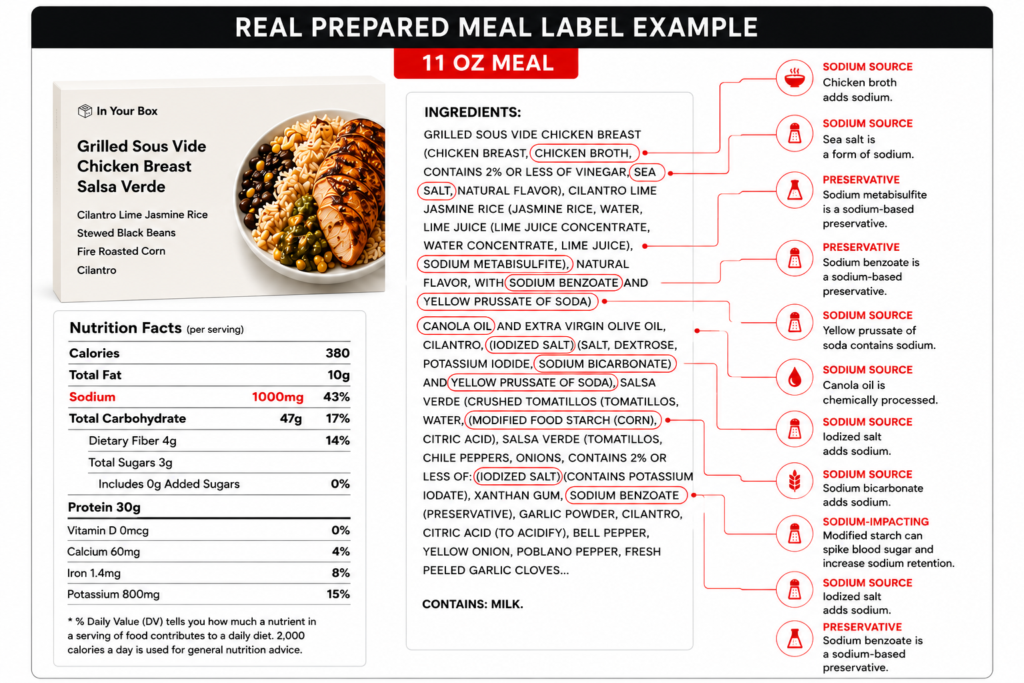
“They say believe half of what you see and none of what you read.
With today’s food labels? You’re better off believing neither.”
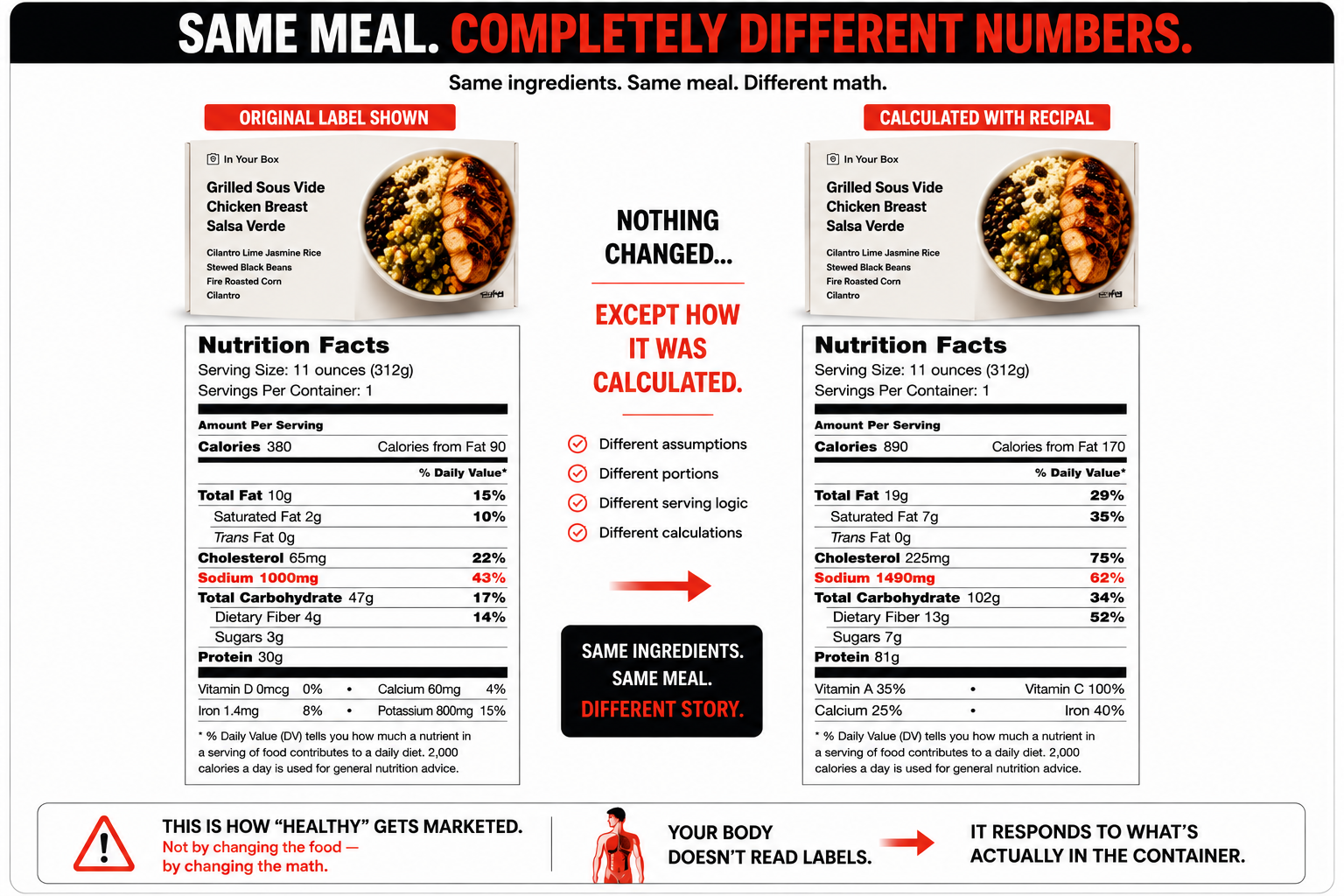
BELIEVE HALF OF WHAT YOU SEE
AND NONE OF WHAT YOU READ.
That’s more true today than ever — especially in the food industry.
Labels are not the truth.
They’re a version of the truth.
Built on estimates, assumptions, and strategies designed to make the numbers look better — not to show you what’s actually in the meal.
**THE REALITY HITS YOUR BODY.
NOT THE LABEL. **
Sodium stacks. Additives load. Preservatives work.
Your body doesn’t care how it’s calculated — it reacts to everything in the container.
DON’T BE FOOLED BY THE MATH.
FOCUS ON REAL FOOD. REAL INGREDIENTS. REAL RESULTS.
THEY CONTROL THE LABEL. YOU CONTROL WHAT YOU EAT. Choose meals that don’t need math to look good.
Why We’re Different (And Why You Should Question That Too)
YOU SHOULD BE SKEPTICAL.
You’ve been sold “healthy” before.
So no — don’t take our word for it.
HERE’S WHAT WE DO DIFFERENTLY:
We don’t start with calories.
We start with how the meal breaks down in your body.
We don’t “hit numbers.”
We build meals that control how those numbers actually behave.
We don’t hide behind labels.
We show you exactly what’s in it — and why it’s there.
AND HERE’S THE PART MOST COMPANIES WON’T SAY:
You can make numbers look good on paper
without changing how the meal performs.
Lower sodium label? Easy.
Just shift where it comes from.
“Diabetic-friendly”?
Even easier. Adjust the math.
That’s not what we do.
HOW YOU CAN VERIFY IT (DON’T TRUST — CHECK):
Read our full ingredient lists
Look for hidden sugars, fillers, preservatives
Compare how meals are actually built — not just labeled
Then compare how you feel after eating them
Because that’s the only metric that doesn’t lie.
**THE DIFFERENCE ISN’T WHAT WE SAY.
IT’S WHAT YOUR BODY EXPERIENCES.**
No guessing.
No spikes you didn’t see coming.
No “this looked healthy but…” moments.
If we were doing what they do…you’d feel it the same way.
We Built This On A Code
There was a time when the firehouse meant something.
Brotherhood wasn’t a slogan.
It was a standard.
You had each other’s back.
No questions. No excuses. No hesitation.
You go. We go.
We go in together – We come out together.
And you never leave someone behind.
That’s the code I come from.
So when we say our meals are built differently —
that’s not marketing.
That’s my name. My reputation. My word.
We don’t hide behind numbers.
We don’t dress up shortcuts and call them healthy.
We don’t build food we wouldn’t feed our own crew.
Because where I come from, trust isn’t claimed. It’s Earned.
And if something carries our name,
it better be built like someone’s counting on it.
Because they are.
Why “Low Sodium” Doesn’t Mean What You Think It Does
Most companies want you focused on a number.
But your body doesn’t eat numbers.
It eats ingredients.
And there’s a massive difference between:
- sodium added intentionally to real food
- and sodium hidden inside ultra-processed food systems built for shelf life, flavor manipulation, and convenience
That’s where most people get misled.
The Real Problem Isn’t Just Salt
Your body needs sodium.
Hydration depends on it.
Muscle function depends on it.
Nerve signaling depends on it.
The issue isn’t sodium itself.
It’s the form it’s delivered in — and what comes with it.
There’s a major difference between:
- balanced seasoning on non-processed food
- mineral-containing sea salts
- naturally occurring sodium in real ingredients
…and sodium spread across:
- preservatives
- sodium compounds
- processed sauces
- flavor enhancers
- shelf-life stabilizers
- ultra-processed ingredient systems
Same word.
Very different outcomes!
Why Most “Low Sodium” Meals Still Miss The Point
Most companies lower sodium one of three ways:
- shrink the portion
- lower the number on the label
- not show sodium at all, or make it beyond difficult to find
- keep the same processed system underneath it
So the marketing improves…
…but the food structure never actually changes.
That means people still end up dealing with:
- hidden additives
- stacked sodium sources
- bloating
- dehydration
- unstable energy
- processed ingredient overload
Because the body isn’t just responding to sodium.
It’s responding to the entire food system surrounding it.
The label changed – the food didn’t.
Controlled Inputs. Different Outcome.
At Fire Dept Meals, we don’t build meals around label manipulation.
We build them around:
- real ingredients
- intentional seasoning
- balanced nutrition
- zero processed inputs
- predictable food structure
Because the goal isn’t:
“less food”
It’s:
better inputs your body can actually work with.
That’s why our meals are designed to feel:
- more stable
- more filling
- less bloating
- more predictable
- easier on your body over time
Because once the inputs change…
everything downstream changes with them.
The Label Looks Better. The Food Didn’t.
Most “low sodium” meals aren’t built differently.
It’sThey’re just marketed differently.
Because reducing one number on a label is easy.
Actually rebuilding the food?
That’s expensive.
So most companies take shortcuts:
- smaller portions
- fake “healthy” claims
- processed ingredients
- hidden behind cleaner wording
- sodium redistributed through additives and compounds
- flavor systems designed to survive shelves instead of support the body
That’s why a meal can say: “heart healthy” …while still being loaded with ultra-processed garbage your body has to fight through.
And that’s the part nobody talks about. Because the issue was never just: salt.
It’s the industrial system wrapped around it.
The preservatives.
The additives.
The flavor manipulation.
The shelf-life engineering.
The fake convenience sold as nutrition.
That’s why people can eat “low sodium” meals and still feel:
- bloated
- inflamed
- exhausted
- dehydrated
- constantly hungry
- completely wrecked at the end of a work day
Because your body still knows the difference between: real food and chemically stabilized survival rations.
At Fire Dept Meals, we don’t chase label tricks.
We rebuild the meal itself.
Real ingredients.
Controlled inputs.
Intentional seasoning.
Food designed to support recovery instead of just surviving shipping.
Because when your schedule already beats the hell out of your body…
your food shouldn’t finish the job.
You Already Know Something’s Off.
You’ve noticed it before. Some meals leave you steady.
Others wreck your energy for the rest of the day.
Some make you feel fueled.
Others feel like your body is trying to survive them.
And deep down…
you already know this isn’t just: “getting older”,“being tired” or “part of the job.”
because eventually your body starts reacting exactly how it’s expected to.
inflammation * water retention * exhaustion * unstable energy * constant convenience eating * recovery getting weaker *repeat
Because ultra-processed food was never designed to support people living under real stress.
And the worst part?
Most people think this is normal now.
Because the entire food system shifted toward:
shelf life * mass production convenience * artificial flavor systems * cheaper ingredients * longer expiration dates
—not better human performance.
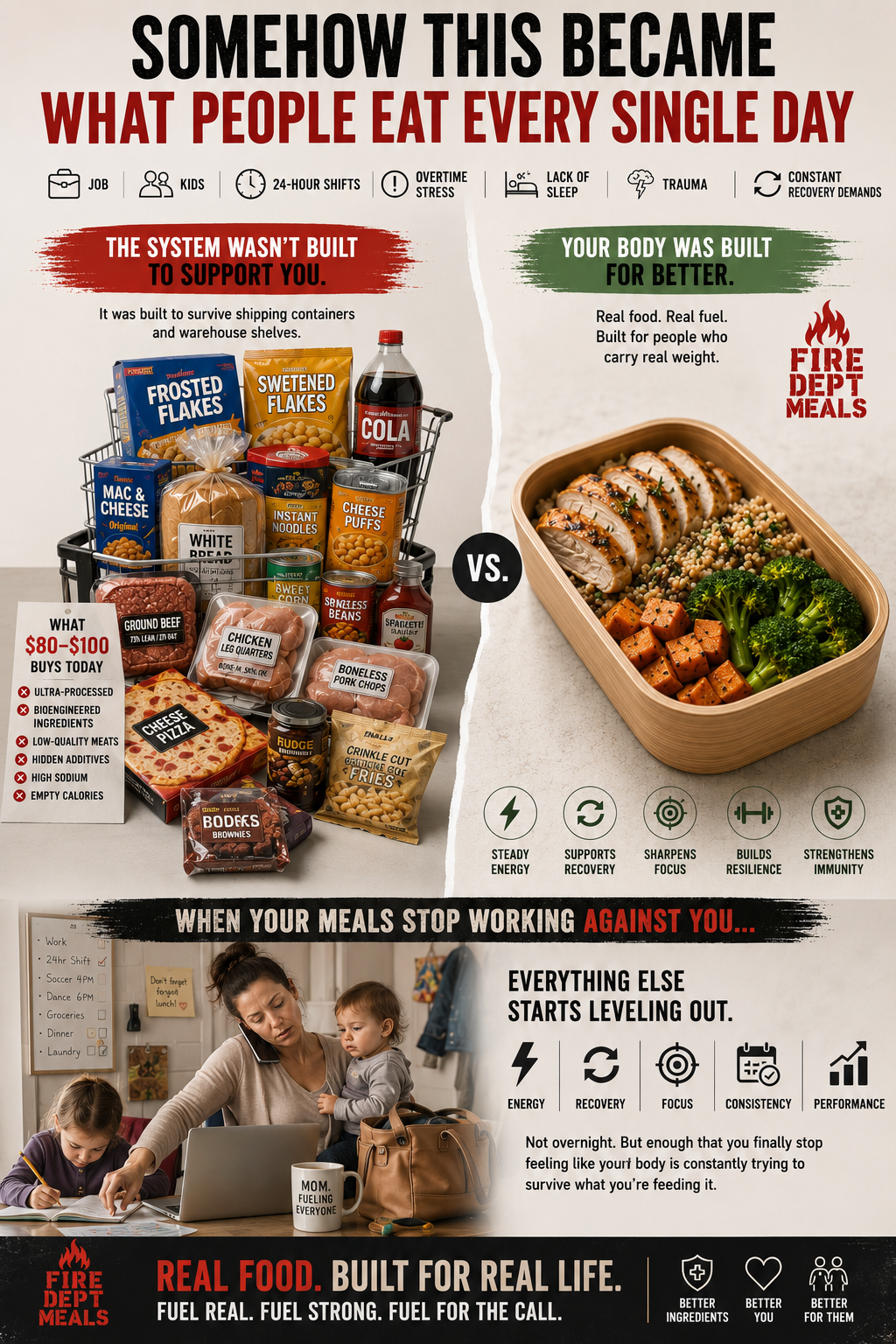
Walk through a grocery store today. Entire aisles are packed with products engineered to survive for months…sometimes years.
“Healthy” foods loaded with preservatives.
Mass-produced meats pumped for consistency.
Ultra-processed convenience meals pretending to be nutrition.
Over half the ingredient labels read like a chemistry experiment.
somehow THIS became what people eat every single day while trying to survive:
job • kids • 24-hour shifts • overtime stress • lack of sleep • trauma • constant recovery demands
The system wasn’t built to support people under real stress. It was built to survive shipping containers and warehouse shelves. That’s a massive difference.
AND YOUR BODY KNOWS IT…
That’s why this isn’t about: eating perfectly.
It’s about finally removing some of the garbage your body has been fighting nonstop for years.
Less ultra-processed overload.
Less hidden sodium systems.
Less ingredient manipulation.
Less fake “health food.”
More meals that actually resemble real food again.
Because when your meals stop working against you…
everything else starts leveling out.
Energy.
Recovery.
Focus.
Consistency.
Performance.
Not overnight.
But enough that you finally stop feeling like your body is constantly trying to survive what you’re feeding it.
YOUR BODY WILL TELL YOU THE DIFFERENCE.
Funny how cheap food feels like a win at checkout…
until your body starts cashing the bill later.
STOP PAYING FOR YOUR MEALS TWICE.
Build your week with meals designed to work WITH your body — not against it.
Stop letting your life write checks, your ass can’t cash.
STOP WONDERING WHY SOME MEALS LEAVE YOU FEELING LIKE GARBAGE.
You shouldn’t have to guess how your body is going to respond after you eat.
With Fire Dept. Meals, the goal is simple:
meals that feel predictable
meals that digest cleaner
meals that stop working against you every day
Water retention shouldn’t feel normal. Constant bloating shouldn’t feel expected. Feeling exhausted after eating shouldn’t be part of “healthy eating.”
MOST PEOPLE TRY TO FIX THE SYMPTOMS…
WITHOUT EVER FIXING WHAT’S CAUSING THEM.
So the cycle keeps going: ultra-processed meals, hidden sodium systems, preservatives, constant convenience food, inflammation, wake up and repeat
Give it 90 days
Not a Weeek end – Not one clean meal – Not when it’s convenient.
Because stability doesn’t come from one “healthy” decisions.
It comes from changing the inputs consistency.
YOUR BODY RESPONDS TO WHAT YOU REPEAT.
That’ s why we focus on: minimally processed ingredients, intentional seasoning, balanced meals, predictable nutrition, less ultra-processed overload
Not fake “health food.”
Not shelf-stable chemistry experiments pretending to support recovery.
Most so-called “healthy meals” aren’t solving the problem. They’re just ultra-processed convenience food with cleaner branding, bigger marketing budgets, and better buzzwords on the label.
That’s why people keep eating “healthy”…
while still feeling inflamed, exhausted, bloated, and frustrated.
Consistency is where the shift happens.
No subscriptions required. No pressure.
Just meals built to work with your body — not against it.
How It Works (Without The Guesswork)
Pick your meals. We handle the rest.
Stay consistent — without overthinking every bite.
1. Choose Your Meals
Pick from rotating meals built around:
balanced nutrition
intentional ingredients
controlled sodium
stable energy
real recovery
Not ultra-processed “health food” loaded with hidden garbage.
No guessing.
No label gymnastics.
No “probably fine.”
Just meals designed to feel consistent every time you eat them.
EVERY MEAL IS BUILT TO SUPPORT RECOVERY —
NOT FIGHT IT.
2. We Prep Everything Fresh
Every meal is prepared in controlled batches using:
real ingredients
balanced macros
minimally processed inputs
intentional seasoning
no refined junk
No mass production.
No warehouse-food mentality.
No shelf-stable chemistry experiments pretending to be wellness.
Built around how the body actually responds after you eat.
IF IT DOESN’T SUPPORT STABILITY, IT DOESN’T GO OUT. PERIOD.
3. Delivered ready to heat
Your meals arrive fresh and sealed.
No prep. No cleanup. No extra decisions after a 12-hour day when your brain isalready cooked.
Heat. Eat. Move on with your life.
Because consistency only works when the system is realistic enough to repeat.
Built for real life — week after week.
4. Stay Consistent
This is where everything starts changing.
When meals stop constantly working against your body…
your system finally has room to stabilize.
Less bloating.
Less heavy meals.
More stable energy.
Better recovery.
Less feeling like garbage after eating.
Not because of some magic “diet.” Because your body finally isn’t fighting ultra-processed inputs nonstop anymore.
THIS IS WHERE YOUR LIFE STARTS WRITING CHECKS, YOUR ASS CAN FINALLY CASH
No Complicated Plans. No Guessing. Just Meals That Work The Way They’re Supposed To.
Most so-called “healthy” meal prep still focuses on: labels, calorie math, fake health marketing, processed shortcuts and convenience systems pretending to be nutrition
Not how your body actually responds after you eat it.
Meanwhile people still feel: exhausted, inflamed, bloated, inconsistent, wrecked after eating. Because the label changed. The food didn’t.
LIFE ALREADY WRITES ENOUGH CHECKS YOUR BODY HAS TO CASH.
Kids
Job
Afterschool Commitments
Long shifts.
Stress.
Lack of sleep.
Drive-thru dinners.
Convenience eating.
Constant recovery demands.
The list is long!
Your meals shouldn’t make that situation worse.
THAT’S WHY FIRE DEPT MEALS EXISTS.
Real ingredients.
Controlled inputs.
Intentional meals.
Built for real life.
Not fake “health food.”
Not warehouse shelf systems pretending to support performance.
Just meals designed to work WITH your body —
week after week.
Stop eating food that keeps working against you.
REAL QUESTIONS. NO LOW-SODIUM MARKETING BULLSH*T.
WHAT ACTUALLY MAKES A MEAL “LOW SODIUM”?
Answer: Most people think “low sodium” simply means: less salt.
That’s only part of the story. A truly low-sodium meal is usually the result of how the entire meal was built long before it ever reaches your plate. Because sodium doesn’t just come from someone shaking table salt onto food anymore.
Modern processed food systems quietly stack sodium into almost everything:
injected meats
bottled sauces
seasoning blends
preservatives
powdered soup bases
frozen meal systems
shelf-stable ingredients
restaurant marinades
That’s why two meals can look similar on paper…while your body responds completely differently afterward.
A real low-sodium meal typically starts with cleaner ingredients that naturally require less sodium to begin with.
Not because the food is bland.
Because the flavor is coming from:
actual cooking
herbs and spices
fresh ingredients
citrus
vinegars
balanced seasoning
real proteins
—not industrial flavor systems designed to survive warehouses for six months.
And honestly, that’s where a lot of people get misled by labels. A frozen “healthy” meal might technically hit a sodium number…
while still being built from heavily processed ingredients carrying sodium through every layer of the meal.
At Fire Dept. Meals, we focus less on chasing trendy label claims and more on controlling the actual inputs.
That means meals intentionally built around:
fresh preparation
cleaner proteins
controlled seasoning
minimally processed ingredients whenever possible
and less unnecessary sodium overload overall
Because the goal isn’t just lowering a number on paper.
It’s building meals your body consistently responds to better over time.
ARE FIRE DEPT. MEALS ACTUALLY LOW SODIUM — OR JUST “LOWER” THAN FAST FOOD?
Answer: “Lower than fast food” is a pretty low bar.
Most drive-thru meals, frozen dinners, and convenience foods are overloaded with sodium before you even touch a salt shaker. The chicken may already be injected with sodium solutions. The sauces are sodium-heavy. The seasoning blends are loaded with salt because it’s cheap and adds bulk. Even the “healthy” side dishes are often packed with preservatives and shelf-stable ingredients carrying sodium through the entire meal.
That’s why a lot of people can eat something labeled, “healthy” and still feel:
bloated
thirsty
sluggish
heavy afterward
The food system itself never really changed.
At Fire Dept. Meals, our approach is different from the start. We focus on controlling the entire build of the meal instead of simply lowering one number on a nutrition label after the fact.
That means paying attention to:
ingredient quality
seasoning systems
sauces
processed additives
sodium-loaded convenience ingredients
and how the body actually responds after eating
Because sodium overload usually happens in layers.
A processed protein here.
A bottled sauce there.
A powdered seasoning blend.
A shelf-stable side item.
Suddenly one “healthy” meal quietly turns into a sodium bomb without most people realizing it.
Our goal is to build meals that naturally stay more controlled because the ingredients themselves are cleaner and not processed to begin with.
Not fake “diet food.”
Not flavorless cardboard meals.
And not ultra-processed food wearing a health halo.
Just meals intentionally built for people who actually care how they feel afterward.
Why Do Most “Healthy” Meals Still Make Me Feel Bloated?
Answer: Because a lot of modern “healthy food” is still built inside the same industrial food system as everything else.
The branding got cleaner. The ingredients didn’t.
A surprising amount of commercial meal prep still depends heavily on:
sodium-loaded seasoning systems
bottled sauces
preservatives
injected proteins
powdered mixes
stabilizers
gums
cheap oils
shelf-stable convenience ingredients
And your body notices.
That’s why people can eat something labeled:
“high protein”
“macro friendly”
“heart healthy”
…and still feel:
swollen
thirsty
sluggish
puffy
heavy after eating
Because bloating usually isn’t caused by one ingredient. It’s the cumulative effect of ultra-processed inputs stacked into every layer of the meal.
A sodium-heavy protein.
A processed sauce.
A packaged side.
A seasoning blend where salt is the first ingredient.
Suddenly the body is trying to manage far more than people realize.
At Fire Dept. Meals, we focus on simplifying the entire system. Cleaner proteins. Scratch-made components whenever possible. Controlled seasoning. Less reliance on heavily processed ingredients designed for warehouse shelves instead of human beings.
That doesn’t mean “perfect food.” It means meals built with intention instead of industrial shortcuts.
And honestly, one of the first things people notice when they consistently stop eating ultra-processed convenience food every day is this:
They stop feeling wrecked after meals.
Less heaviness.
Less bloating.
Less feeling like food just picked a fight with their body.
That’s a massive difference most people forgot food was even capable of making.
IS SODIUM THE PROBLEM — OR IS IT THE TYPE OF FOOD IT’S COMING FROM?
Answer: That’s where this conversation usually gets oversimplified.
Your body actually needs sodium.
Hydration depends on it.
Muscle function depends on it.
Nerve signaling depends on it.
People sweating through long shifts, workouts, heat, stress, and exhaustion especially understand that quickly.
The bigger issue is where most people are getting sodium from now.
Because modern sodium overload usually isn’t coming from someone lightly seasoning fresh food at home.
It’s coming from industrial food systems where sodium gets layered into almost everything:
injected meats
bottled sauces
frozen convenience meals
powdered seasoning blends
deli meats
restaurant food
shelf-stable ingredients
preservatives and stabilizers
That’s a completely different situation.
Take grocery store chicken for example. A large percentage of commercial chicken is “enhanced” with sodium solutions before it even hits the shelf. Then people add packaged marinades, sodium-heavy seasonings, bottled sauces, and processed sides on top of it without realizing how quickly the overload builds.
The body isn’t just responding to “salt.”
It’s responding to an entire ultra-processed food environment constantly pushing sodium through every layer of the meal.
That’s why so many people feel:
bloated
constantly thirsty
sluggish
swollen
heavy after eating
And most assume: “that’s just normal.”
At Fire Dept. Meals, we focus more on simplifying the food itself instead of chasing trendy label claims. Cleaner proteins. Controlled seasoning. Scratch-made components whenever possible. Less dependence on industrial food systems designed around shelf stability instead of human performance.
Because there’s a massive difference between:
sodium supporting the body
and
sodium being used to hold together a heavily processed food system.
DO YOUR MEALS USE PROCESSED INGREDIENTS OR PRESERVATIVES?
Answer: We do not use any products that have come from an ultra-processed ingredient systems that dominates most meal prep and modern food production.
Because once food gets engineered around:
warehouse storage
ultra-long shelf life
mass production
transportation stability
artificial consistency
…the ingredient list usually starts turning into a science project.
That’s where you start seeing:
sodium-loaded preservatives
stabilizers
gums
artificial flavor systems
cheap filler oils
powdered sauce bases
chemically enhanced proteins
And honestly, most people have been eating that stuff so long they barely question it anymore.
At Fire Dept. Meals, we take a much more old-school approach whenever possible.
We use things like:
citrus juices
vinegars
natural acidity
sea salt
controlled preparation methods
fresh cooking practices
to help maintain freshness instead of relying heavily on industrial preservation systems built for maximum shelf survival.
Because there’s a huge difference between:
preserving food
and
engineering food to survive the apocalypse in a warehouse.
Modern grocery stores normalized food lasting:
weeks
months
sometimes longer than common sense should allow
And people stopped asking: “What exactly had to happen to make food last this long?”
That question matters.
Now realistically, no modern food system is perfect. Some ingredients still require processing at some level simply because of how large-scale supply chains work today.
But there’s a massive difference between:
minimally processed ingredients supporting a real meal
and
ultra-processed systems pretending to BE the meal itself.
That’s the line we care about.
Because eventually your body responds to what you repeatedly feed it — whether the label sounds healthy or not.
WHY DOES ULTRA-PROCESSED FOOD CAUSE WATER RETENTION?
Answer: Most people assume water retention is simply a sodium problem.
In reality, it’s usually a food system problem.
Water retention often happens when the body is constantly dealing with meals loaded with:
excessive sodium
preservatives
processed carbohydrates
artificial ingredients
cheap oils
heavily engineered food products
The body has to maintain balance. When those inputs start showing up meal after meal, day after day, it often responds by holding onto more water than it should.
That’s why so many people describe feeling:
puffy
swollen
bloated
thirsty all the time
heavier than normal
Sometimes the scale jumps several pounds in a day or two and people assume they suddenly gained body fat.
They didn’t. Most of the time they’re carrying extra water because of what they’ve been eating. The modern food industry doesn’t help much either. Many processed foods are intentionally engineered to retain moisture because water adds weight, improves texture, extends shelf life, and increases profitability. The same philosophy often carries into the ingredients being used throughout the meal itself.
At Fire Dept. Meals, we focus on reducing that burden wherever possible.
Not because water retention is some cosmetic issue.
Because when people are constantly retaining water, they often feel worse too.
Less comfortable.
Less energized.
Less recovered.
Less like themselves.
That’s why we focus on meals built around cleaner ingredients, controlled seasoning, and zero reliance on the heavily processed systems that dominate so much of modern food.
Because food should help the body maintain balance.
Not constantly force it to compensate.
ARE YOUR MEALS GOOD FOR HIGH BLOOD PRESSURE SUPPORT?
Answer: One of the biggest misconceptions about blood pressure is that people think it can be blamed on a single ingredient.
Usually it isn’t that simple.
High blood pressure is influenced by a long list of factors including:
stress
sleep quality
body weight
physical activity
hydration
medications
genetics
overall dietary patterns
That’s why two people can eat the exact same meal and have completely different outcomes.
What we do know is that health organizations have consistently encouraged people concerned about blood pressure to pay attention to sodium intake and, more importantly, the quality of the food delivering that sodium. That’s a distinction many people miss.
For example, a baked potato with some sea salt and a grilled chicken breast is very different from consuming the same amount of sodium through ultra-processed convenience foods loaded with preservatives, stabilizers, and heavily refined ingredients.
The sodium number might look similar on paper. The food surrounding it is not.
At Fire Dept. Meals, we focus on building meals around:
controlled sodium levels
real ingredients
balanced nutrition
zero already processed foods
Because the goal isn’t to create a medical treatment. The goal is to give people better nutritional inputs than what they’re typically finding in drive-thrus, vending machines, gas stations, break rooms, and freezer aisles.
And honestly, that’s where many people start seeing the biggest difference.
Not because of one miracle ingredient. Because they finally stop asking their body to fight the same nutritional battle three times a day.
As always, anyone with high blood pressure or a medical condition should follow the guidance of their physician or healthcare provider.
Additional information can be found through the National Institutes of Health and the American Heart Association.
Our job is simply to make eating cleaner and controlling unnecessary sodium a whole lot easier.
WHAT TYPES OF SALT DO YOU USE IN YOUR MEALS?
Answer: We use sea salt and incorporate it into our own scratch-made seasoning blends rather than relying on the commercial seasoning systems used throughout much of the food industry.
Why does that matter? Because many commercial spice blends aren’t really spice blends at all.
They’re salt-delivery systems.
Take a look at the ingredient panel on many:
Cajun seasonings
taco seasonings
steak rubs
blackening blends
barbecue rubs
More often than not, salt is the first ingredient.
Not garlic.
Not paprika.
Not herbs.
Salt.
That’s because salt is inexpensive, adds bulk, boosts flavor quickly, and helps manufacturers create consistency at scale.
The same thing happens with many bottled sauces, powdered Alfredo mixes, soup bases, gravy packets, marinades, and shelf-stable flavor systems. Sodium gets layered into every component until a meal becomes far saltier than most people realize.
At Fire Dept. Meals, we take a different approach.
We build our own seasoning systems around herbs, spices, aromatics, citrus, vinegars, and balanced seasoning techniques. Salt is part of the equation, but it isn’t the entire equation.
Our goal is simple:
Let the food provide the flavor.
Not just the sodium.
Because once ingredients are doing the heavy lifting, you don’t need to bury everything under a mountain of salt to make it taste good. And honestly, that’s one of the biggest misconceptions in modern food.
Most people have been taught that low sodium means bland food. In reality, it often means the cook actually knows how to build flavor.
WHY DO SOME MEALS LEAVE ME FEELING EXHAUSTED AFTER EATING?
Answer: Most people assume food is supposed to give them energy.
And eventually it does. But first, your body has to digest it. That process requires work.
After a meal, blood flow shifts toward the digestive system. Hormones change. Nutrients are absorbed. Your body begins sorting, processing, storing, and utilizing what you just ate. That’s completely normal. What isn’t normal is feeling like you need a nap after every meal. That’s where food quality and meal composition start to matter.
A heavily processed meal often forces the body to work harder than it should. Large amounts of refined carbohydrates, heavy sauces, excessive sodium, poor-quality fats, and artificial ingredients can create the perfect recipe for what people commonly call a “food coma.”
You know the feeling. You finish eating and suddenly:
your energy drops
your focus disappears
your motivation tanks
all you want is a couch
Many people experience that so often they assume it’s a normal part of eating.
It isn’t.
A well-built meal should leave you feeling satisfied, not sedated.
That’s one reason we focus on balanced meals built around quality proteins, controlled ingredients, intentional portions, and real food instead of highly engineered convenience systems. The goal isn’t to create a temporary energy spike. It’s to help create meals that support more consistent energy throughout the day.
Because after a long shift, a stressful day, or a poor night’s sleep, the last thing most people need is food that makes them feel even more exhausted than they already are.
CAN LOW-SODIUM MEALS STILL TASTE GOOD?
Answer: For a lot of people, the answer starts with a surprising realization:
Your taste buds adapt to whatever you feed them consistently.
Think about coffee. The first time most people drink black coffee, they hate it. Then eventually it becomes normal.
The same thing happens with sugar.
And the same thing happens with sodium.
When someone spends years eating:
restaurant food
fast food
frozen meals
heavily processed snacks
bottled sauces
commercial seasoning blends
their palate gradually adapts to higher and higher levels of sodium.
Eventually, food starts needing more salt just to taste “normal.” That’s not because low-sodium food tastes bad. It’s because the baseline keeps moving. The food industry understands this extremely well.
The more intense the flavor system becomes, the more consumers expect that intensity every time they eat.
That’s one reason heavily processed foods often taste incredibly flavorful in the moment but strangely disappointing when compared to real food prepared from quality ingredients.
At Fire Dept. Meals, we focus on building flavor differently.
Instead of relying on sodium overload, we use cooking techniques, ingredient quality, herbs, spices, aromatics, citrus, vinegars, and scratch-made components to create depth of flavor. Something interesting happens when people eat this way consistently. After a few weeks, many discover they can suddenly taste things they barely noticed before.
The natural sweetness of vegetables.
The flavor of herbs.
The richness of proteins.
The complexity of spices.
Food starts tasting more like food again.
And once that shift happens, many people find that the ultra-salty foods they used to love start tasting overwhelmingly salty.
That’s not because the food changed….It’s because their palate did.
Which leads to an important point:
Low sodium doesn’t have to mean less flavor.
Sometimes it simply means allowing the actual ingredients to finally do the talking.
WHAT MAKES FIRE DEPT. MEALS DIFFERENT FROM GROCERY STORE “HEALTHY” MEALS?
Answer: Most people compare meal prep companies by looking at:
calories
protein
carbohydrates
sodium
But there’s another question almost nobody asks:
How long is this food supposed to last?
Seriously. Walk through your grocery store sometime. Look at the expiration dates.
Many “healthy” meals, packaged foods, sauces, proteins, snacks, and convenience products are designed to survive weeks, months, and sometimes far longer than most people realize.
Now ask yourself:
What had to happen to the food to make that possible?
Because food doesn’t magically become shelf stable. It gets engineered that way.
Sometimes that means preservatives.
Sometimes that means stabilizers.
Sometimes it’s modified atmosphere packaging.
Sometimes it’s ingredient systems specifically designed to extend shelf life, improve consistency, retain water, survive transportation,
and reduce product loss.
Why? Because manufacturers have a very different problem than we do.
They’re trying to create food that can survive:
production facilities
transportation networks
distribution centers
warehouse storage
retail shelves
consumer refrigerators
all before it’s ever eaten.
That’s a massive challenge. And the longer food needs to survive…the more the product often has to be engineered around shelf life.
At Fire Dept. Meals, we take the opposite approach.
Our meals are generally designed for about 10 days refrigerated because they’re built to be eaten.
Not displayed.
Not warehoused.
Not forgotten in the back corner of a grocery store cooler while someone waits for a markdown sticker.
Could we make food last longer? Of course.
The entire food industry has figured out how to do that.
The better question is:
Should that be the goal?
Because somewhere along the way, the conversation shifted from:
“How do we make better food?”
to
“How do we make food last longer?”
Those are two very different missions. And they don’t always lead to the same destination.
We’re not interested in building meals that survive the apocalypse.
We’re interested in building meals that support real people living real lives.
Long shifts.
Kids.
Stress.
Recovery.
Workouts.
Life.
Because fresh food having an expiration date isn’t a problem.
It’s often a reminder that you’re still eating actual food.
And honestly? That’s becoming rarer than it should be.
WHY DO MOST MEAL PREP COMPANIES STILL USE PROCESSED INGREDIENTS?
Answer: Why do all restaurants and most meal prep companies do it? COST. Most people assume food companies make decisions based on nutrition.
The reality is usually much simpler. They make decisions based on economics. Imagine you’re running a meal prep company and you have two choices. You can make Alfredo sauce from scratch every week using cream, cheese, garlic, and seasonings. Or you can open a powdered Alfredo base, add water, and have the same product every single time.
Which one is easier?
Which one is cheaper?
Which one creates less waste?
Which one requires less labor?
You already know the answer.
Now multiply that decision across hundreds of ingredients and thousands of meals.
That’s where much of modern food comes from. The challenge isn’t that food companies are trying to make bad food. The challenge is that they’re often trying to make food that is easier to produce, easier to store, easier to ship, and easier to scale.
Those goals don’t always create the best meal.
Fresh ingredients are unpredictable.
Tomatoes change with the season.
Peppers vary in heat.
Herbs fluctuate in flavor.
Proteins differ from batch to batch.
Real food has personality. Manufacturing systems hate personality. They want consistency.
That’s why so many companies turn toward processed ingredients, powdered sauce systems, pre-made seasoning blends, and shelf-stable components. Those products remove variables and make production easier.
The problem is that consumers often mistake “efficient food” for “better food.” They’re not the same thing.
At Fire Dept. Meals, we fight that battle constantly.
Making our own spice blends takes more work.
Preparing fresh components takes more work.
Working with real ingredients creates more challenges.
Quite honestly, there are days when the easy path would make life a whole lot simpler.
But we didn’t build Fire Dept. Meals because we wanted the easiest way to make food.
We built it because we wanted to make better food.
And those two goals rarely lead to the same place.
Somewhere along the way, much of the food industry became obsessed with efficiency.
We stayed obsessed with the meal.
That’s a very different philosophy.
And it’s one of the biggest reasons food made for spreadsheets rarely performs as well as food made for people.
ARE YOUR MEALS BUILT TO SUPPORT RECOVERY AND STABLE ENERGY?
Answer: Most people think recovery is something that happens after a workout. Or after a long shift. Or while they’re sleeping.
In reality, recovery never stops.
Right now, as you’re reading this, your body is repairing tissue, producing hormones, replacing cells, regulating inflammation, supporting your immune system, and trying to maintain balance across thousands of biological processes.
Recovery isn’t an event.
It’s a constant process.
The problem is that modern life isn’t exactly helping.
Most people are trying to recover from:
poor sleep
chronic stress
long work hours
shift schedules
family obligations
lack of downtime
convenience eating
All at the same time. Eventually, something has to give.
That’s one reason stable energy becomes so important.
People often chase energy through caffeine, energy drinks, sugar, or sheer stubbornness. But real energy isn’t something you manufacture out of thin air. It’s something the body creates when it has the resources to do its job properly.
That’s why we build meals around consistency.
Not magic ingredients.
Not miracle foods.
Consistency.
Balanced proteins.
Intentional ingredients.
Controlled nutrition.
Meals designed to help support the demands people place on their bodies every day. Because the goal isn’t simply helping someone get through lunch. The goal is helping them create better inputs for the thousands of recovery decisions their body is making every single day.
Especially when life keeps writing checks that the body eventually has to cash.
And for most people, that’s the real challenge.
Not one workout.
Not one meal.
Not one bad day.
The accumulation of everything.
That’s why we believe stable energy and recovery are less about finding a shortcut and more about giving the body fewer obstacles to fight through in the first place.
HOW MUCH SODIUM IS ACTUALLY TOO MUCH?
Answer: This is one of the most common nutrition questions people ask.
It’s also one of the hardest to answer with a single number. Because sodium needs are highly dependent on the person.
A construction worker sweating in the Florida summer is not the same as someone sitting behind a desk all day.
A firefighter working a 24-hour shift isn’t the same as someone spending most of the day indoors.
An endurance athlete doesn’t have the same needs as someone who is largely sedentary.
That’s why sodium can be such a confusing topic. Your body actually needs sodium. Without it, you can’t properly regulate hydration, muscle contractions, nerve signaling, or fluid balance.
The problem isn’t that sodium exists.
The problem is that many people consume large amounts of sodium without realizing where it’s coming from.
A breakfast sandwich.
A canned soup.
A deli sandwich.
A bottled sauce.
A frozen dinner.
By the end of the day, sodium has quietly accumulated across multiple meals without anyone consciously adding much salt at all.
That’s why the conversation shouldn’t start with:
“How much sodium am I putting on my food?”
It should start with:
“How much sodium is already in my food before I ever touch a salt shaker?”
That’s where many people are shocked.Some commercial meals contain more sodium in a single serving than a home cook would use across multiple meals.
Context matters.
Activity level matters.
Hydration matters.
Overall food quality matters.
And individual health conditions matter.
That’s why we focus on controlling unnecessary sodium where we can while still building meals that taste like real food.
Organizations such as the American Heart Association and the CDC provide educational resources and general sodium intake guidance, but individual needs can vary significantly based on activity level, health status, environment, and lifestyle.
Because the goal isn’t eliminating sodium.
The goal is understanding it.
And once people understand where sodium actually comes from, they tend to make much better decisions without obsessing over every milligram.
WHY DOES FAST FOOD MAKE ME FEEL SWOLLEN AND SLUGGISH?
Answer: Most people blame one ingredient.
Usually sodium.
Sometimes carbohydrates.
Sometimes fat.
The reality is usually much bigger than that. Fast food often creates what you could call a “perfect storm” inside the body.
It’s not one thing. It’s everything showing up at the same time.
A typical fast-food meal may contain heavily processed proteins, refined carbohydrates, cheap oils, sodium-loaded sauces, preservatives, flavor enhancers, and large calorie loads all packed into a single sitting.
Your body now has to process all of it. At once.
That’s one reason people often experience the same pattern:
They eat.
They feel satisfied for a short period.
Then the bloating starts.
Energy drops.
Thirst increases.
Focus gets foggy.
And suddenly a nap sounds like a fantastic idea. Most people assume that’s normal. It’s not.
Food should require digestion. It shouldn’t feel like a full-time job.
Part of the issue is that fast food is engineered for immediate satisfaction. It’s designed to be highly flavorful, highly craveable, and incredibly convenient.
What it’s not necessarily designed for is how you feel three hours later. Or tomorrow morning. Or after eating that way consistently for years.
At Fire Dept. Meals, we look at food differently.
We’re not just interested in whether something tastes good for ten minutes.
We’re interested in how it performs afterward. Because food doesn’t stop working when you finish eating it.
The body is still dealing with the consequences hours later.
That’s why many people notice something surprising when they start eating cleaner, more intentional meals consistently.
They don’t just feel better after eating.
They stop expecting to feel terrible afterward.
And honestly, that might be one of the biggest signs that food is finally doing what it was supposed to do all along.
ARE THESE MEALS GOOD FOR FIRST RESPONDERS, SHIFT WORKERS, AND HIGH-STRESS JOBS?
Answer: Honestly, that’s exactly who we built them for.
Most nutrition advice sounds great until real life shows up.
Meal prep your lunches.
Cook every meal from scratch.
Shop three times a week.
Get eight hours of sleep.
Reduce stress.
Sounds fantastic. Now try doing that while working a 24-hour shift, getting mandatory overtime, raising kids, responding to emergencies, rotating schedules, or getting called into work on your day off.
That’s where most nutrition plans fall apart.
Not because people don’t care.
Because life gets in the way.
And life gets in the way a lot.
One of the biggest challenges for shift workers isn’t knowledge. Most people already know they should eat better.
The challenge is consistency.
It’s hard to make good decisions when you’re exhausted.
It’s hard to cook when you haven’t slept.
It’s hard to prioritize nutrition when the day feels like controlled chaos.
That’s why we built Fire Dept. Meals around a simple idea:
Make the better choice easier to make.
Because the reality is that first responders, nurses, military personnel, dispatchers, mom’s, dad’s and other high-stress professionals are often asking more from their bodies than the average person.
Long hours.
Interrupted sleep.
Higher stress.
Greater recovery demands.
More wear and tear.
The last thing they need is food creating another problem to solve.
That’s why our focus has never been on creating meals for people living perfect lives.
We’ve always built meals for people living real ones.
The goal isn’t to win a bodybuilding competition.
The goal is to make it easier to consistently put better fuel into a body that’s already carrying a heavy load.
Because life is going to keep writing checks.
The question is whether your body has the resources to keep cashing them.
WHAT HAPPENS WHEN YOU STOP EATING ULTRA-PROCESSED FOOD EVERY DAY?
Answer: Most people expect some dramatic transformation.
The truth is usually much less exciting. And much more powerful.
The first thing many people notice isn’t weight loss. It’s awareness.
They start realizing how different they feel after meals.
How different their energy feels throughout the day.
How different their hunger patterns become.
Because for years, many people have been living inside the same cycle:
Convenience food.
Energy crash.
Caffeine.
More convenience food.
Repeat.
The cycle becomes so normal that people stop questioning it.
Then something interesting happens. When ultra-processed food stops showing up at every meal, the body finally gets an opportunity to stop constantly compensating for it.
For some people, that means less bloating.
For others, it means more stable energy.
Some notice they aren’t as hungry all the time.
Others realize they’re sleeping better, recovering better, or simply feeling more consistent throughout the day.
But here’s where people often get frustrated.
They expect decades of habits to reverse themselves in a week.
That’s not how the body works.
Many people begin noticing changes within days or weeks, but the bigger improvements often happen over months of consistency.
A good rule of thumb is to think in terms of 90 days, not 9 days.
Why? Because your body is constantly adapting.
Taste buds adapt.
Hormones adapt.
Energy patterns adapt.
Recovery patterns adapt.
Food cravings adapt.
The body gradually learns to operate in a different nutritional environment.
That’s one reason people often look back after several months and realize:
“I didn’t notice the change happening day by day, but I definitely don’t feel the same anymore.”
That’s the power of consistency.
Not perfection.
Consistency.
At Fire Dept. Meals, we don’t believe in miracle foods, detoxes, cleanses, or overnight transformations.
We believe the body is remarkably good at doing its job when it consistently receives better inputs.
And honestly?
That’s where most people discover the biggest difference.
Not in one meal.
Not in one week.
But in finally realizing how much better normal can feel after giving the body enough time to adapt.
WHY DO “LOW SODIUM” LABELS SOMETIMES FEEL MISLEADING?
Answer: Because nutrition labels are only as accurate as the information used to create them.
Most consumers assume every food product is individually tested and perfectly measured. The reality is often much more complicated.
Nutrition labels are frequently built using a combination of:
ingredient databases
supplier specifications
recipe calculations
laboratory testing
production estimates
That means the final label is only as accurate as the ingredients, measurements, and the person entering the information. If a supplier changes an ingredient, a recipe changes, a measurement varies, or a product is reformulated, the nutrition profile can change as well.
That’s one reason nutrition labels are best viewed as useful tools—not perfect representations of reality. But there’s another issue most people never think about. Many consumers assume a nutrition label tells the entire story.
It doesn’t.
Some labels provide extensive information. Others focus only on the basics:
calories
protein
carbohydrates
fat
Meanwhile, important details about ingredients, additives, processing methods, preservatives, and overall food quality may require digging much deeper into the ingredient statement itself. And that’s where many people get surprised.
Because two products can have remarkably similar nutrition panels while being built from completely different ingredient systems.
One may be prepared from relatively simple ingredients. The other may rely on a long list of additives, stabilizers, flavor systems, preservatives, and manufacturing shortcuts that never show up in the numbers most people are looking at.
That’s why we encourage people to view nutrition labels as a starting point—not the final answer.
The label can tell you what’s on paper.
The ingredient list often tells you what’s actually in the food.
And at the end of the day, your body responds to both.
WHY DO SO MANY GROCERY STORE FOODS CONTAIN SO MUCH SODIUM?
Answer: Most people think sodium enters their diet from one obvious source:
The salt shaker.
In reality, much of the sodium people consume every day was added to food long before they ever brought it home. That’s because sodium isn’t just used for flavor. Modern food manufacturers use sodium to solve a surprising number of problems.
It can help with:
preservation
moisture retention
texture
consistency
shelf life
curing
food safety
flavor enhancement
In other words, sodium is often working behind the scenes long before anyone tastes the product.
One of the easiest places to see this is with commercial chicken.
Many consumers are surprised to learn that a large percentage of grocery store chicken is sold as “enhanced” poultry. These products may contain added solutions made from water, salt, broth, phosphates, flavorings, or other ingredients designed to improve tenderness, moisture retention, consistency, and shelf life.
According to the USDA, many poultry products contain retained solutions added to improve moisture, tenderness, and consistency.
Look closely and you’ll often see statements such as:
“Contains up to X% retained solution”
or
“Enhanced with a solution of water, salt, and natural flavorings.”
That extra sodium didn’t come from your kitchen. It was already there.
But chicken is only one example.
The same pattern shows up throughout the grocery store in processed meats, deli meats, frozen meals, canned products, bottled sauces, seasoning blends, soup bases, snack foods, and countless convenience products.
What makes it even more confusing is that sodium doesn’t always appear simply as “salt.” It can show up as phosphates, nitrates, nitrites, bicarbonates, preservatives, curing agents, and flavor enhancers throughout the food system.
In other words:
Sodium wears a lot of disguises.
That’s why many people are shocked when they start paying attention to where their sodium is actually coming from.
It often isn’t the salt they’re adding.
It’s the sodium that was already added before the food ever reached their plate.
And that’s why we encourage people to look beyond the front label.
Because one of the most important questions you can ask isn’t:
“How much salt did I add?”
It’s:
“How much sodium was already there before I took the first bite?”
CAN PROCESSED FOODS AFFECT RECOVERY AND INFLAMMATION?
Answer: One of the biggest misconceptions in nutrition is that recovery only matters after a workout.
In reality, recovery is happening every minute of every day.
Your body is constantly:
repairing tissue
replacing cells
regulating hormones
supporting immune function
managing stress
maintaining balance
Even while you’re sleeping.
The question isn’t whether recovery is happening. The question is how many obstacles you’re placing in its path.
Think about the average person today.
They’re already trying to recover from:
long work hours
poor sleep
stress
family responsibilities
lack of downtime
environmental exposures
aging
That’s a pretty full workload before food even enters the conversation. Now add meals built primarily around highly processed ingredients, excessive sodium systems, refined carbohydrates, cheap oils, and heavily engineered convenience foods.
Can the body still do its job? Of course.
The human body is remarkably resilient. But resilience and optimization aren’t the same thing.
At some point, many people begin noticing that they don’t recover like they used to.
They’re more tired.
More sore.
More inflamed.
More dependent on caffeine.
More likely to feel run down.
The answer isn’t always one ingredient or one meal.
It’s often the accumulation of thousands of decisions made over years.
That’s why we focus so heavily on consistency instead of perfection.
Not because a single meal changes everything.
Because recovery is cumulative.
And so are the inputs that support it.
At Fire Dept. Meals, we believe the goal isn’t to create miracle foods.
The goal is to remove some of the unnecessary obstacles your body is fighting every day.
Because life is already difficult enough.
Your food doesn’t need to become another challenge your body has to overcome.
WHY DOES CLEAN NUTRITION MATTER MORE AS YOU GET OLDER?
Answer: At some point, almost everyone notices the same thing.
The foods that never seemed to bother you twenty years ago suddenly start hitting differently.
The late-night pizza.
The drive-thru dinner.
The gas station breakfast.
The energy drink replacing an actual meal.
The convenience foods that once felt harmless now leave you feeling exhausted, bloated, sluggish, or completely wiped out the next day.
Most people simply blame age. And yes, age is part of the equation.
But it isn’t the whole story. The reality is that your body spends your entire life adapting, recovering, repairing, and compensating for the choices you make every day.
When you’re younger, the margin for error is enormous. You can survive on terrible sleep, questionable food, too much stress, and a diet that would make a nutritionist cry.
The body is incredibly resilient. But eventually the bill starts showing up.
Not because your body suddenly stopped working. Because it spent decades cashing checks.
And eventually there are fewer resources available to keep covering the tab.
Recovery becomes more important.
Sleep becomes more important.
Movement becomes more important.
And the quality of the fuel you’re putting into the system becomes far more noticeable.
That’s why so many people reach a point where they say:
“I can’t eat like I used to.”
They’re right. Not because food suddenly became worse.
Because the body no longer has the same margin for error it once did.
The good news? The opposite is true too.
When people consistently improve the quality of what they eat, they often begin noticing changes that have nothing to do with chasing the perfect diet.
More stable energy.
Better recovery.
Fewer afternoon crashes.
Less bloating.
Less feeling like every meal requires a recovery period of its own.
And here’s the part nobody likes to hear:
Those changes usually don’t happen in a week.
Or even a month.
The body needs time to adapt.
Time to establish new patterns.
Time to stop compensating for years of convenience eating and start operating in a different nutritional environment.
That’s why we talk so much about consistency.
Not perfection.
Consistency.
Because getting older isn’t optional. But continuing to feed the body the same way you did at twenty while expecting it to perform like it’s twenty?
That’s usually where the problems begin.
At Fire Dept. Meals, we don’t believe in miracle foods, detoxes, or overnight transformations.
We believe the body is remarkably good at doing its job when it consistently receives better inputs.
And the older we get, the more important those inputs become.
Stop Guessing How You’re Going To Feel After You Eat.
Because life is hard enough.
Your food shouldn’t be another problem to solve.
You don’t need perfection.
You need consistent.
Start with one week. Your body will tell you the difference.
Additional Resources:
Want to learn more about sodium, food quality, and nutrition?
- American Heart Association — Sodium & Heart Health
- CDC — Sodium Consumption & Blood Pressure
- USDA — Enhanced Poultry & Retained Solutions
- Harvard Nutrition Source — Nutrition & Food Quality